Fractional AI Operations
Run a lean team
like a big one.
I build the automation layer that lets small teams operate like companies ten times their size — onboarding, customer support, and reporting that runs without anyone babysitting it.
Senior operator. No hype. Outcomes and ROI, not buzzwords.
/ automation flow
The reality
Your team is doing big-company work with a small-company headcount.
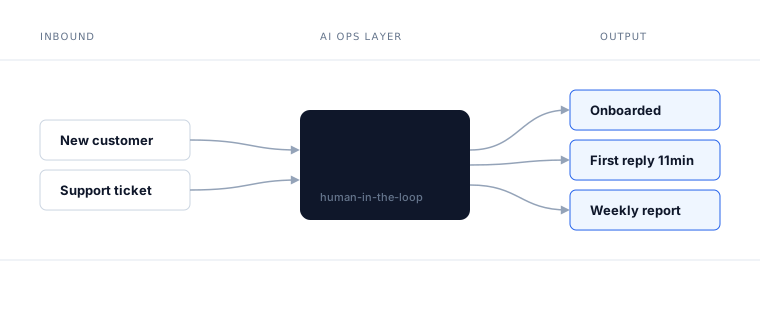
Onboarding is a checklist someone forgets. Support tickets pile up because everyone is already buried. The weekly numbers take half a day to pull together — if they get pulled together at all.
You don't need more people. You need the repetitive work to run itself, with your team in the loop only where judgment is required. That's the whole job: take the copy-paste work off your people so they can do the work only people can do.
/ packages
Three ways to work together.
Fixed scope, fixed pricing. You always know what you're paying before anything starts.
/ how it works
Audit, build, hand off.
Audit
Two weeks. We map every manual workflow, sit in on your ops, and rank the automation wins by ROI. You leave with a roadmap you could hand to anyone.
Build
Four to six weeks. We implement the highest-leverage automations first — onboarding, support, reporting — wired into the tools you already use, with a human in the loop where it matters.
Handoff / Retain
Your team owns it, documented and tested. Stay on retainer for ongoing optimization and new automations, or take it and run. No lock-in.
/ results
What changed for lean teams.
Real engagements. Specific numbers. No fluff.
Series A SaaS · 14-person team post-layoff
The problem
New hire onboarding took 6+ hours per person across HR, CS, and ops — scattered across Notion, Slack, and Google Workspace with no owner.
What was built
Automated Slack workspace provisioning + Notion workspace setup triggered on hire event in Rippling, with a role-specific onboarding checklist and manager notification flow.
Result
Onboarding time cut from 6 h → 19 min. HR and ops reclaimed 8 hrs/week. First-day experience score went from 5.8 → 8.9.
— Sarah K., Head of Operations
Seed-stage marketplace · 8-person team
The problem
Support inbox was swamped with 40+ tickets/day. Average first-response time hit 11 hours. One ops person was spending half their week triaging tickets that had obvious answers.
What was built
AI triage layer (GPT-4o + Zendesk) that classifies, auto-resolves ~60% of tickets from a KB, and escalates the rest with full context and suggested replies pre-written.
Result
First-response time dropped from 11 h → 4 min. Team handles 2× ticket volume with zero new headcount. CSAT up 18 points.
— Marcus T., CEO
Series A fintech · 11-person ops team post-RIF
The problem
Weekly ops report took 4–5 hours to assemble manually from Stripe, Mixpanel, and HubSpot. Numbers were often wrong, always late, and the CEO was making decisions on week-old data.
What was built
Automated data pipeline pulling from all three sources into a live Notion dashboard, with a formatted Slack digest delivered every Monday at 7 AM before standup.
Result
4.5 hrs/week recovered. Execs see accurate metrics before Monday standup. Two data errors caught in the first month that would have affected board reporting.
— Priya N., VP of Operations

/ the operator
“I thought getting laid off meant I lost my future.”
When my role was cut, the hardest part wasn't the paycheck. It was the quiet fear that the thing I was good at had moved on without me. I rebuilt from my garage — and what I learned is that the systems big companies pay teams to run can be built and operated by one person who knows where the leverage is.
Now I build those systems for founders trying to run lean. Not to replace anyone — to make sure the people you have don't burn out doing work a machine should be handling. If you're afraid of being left behind, I've been there. The way out is to build.
Ryan Martinez
Founder, Fractional AI Ops
/ questions
The honest answers.
What stack do you build on?
Whatever you already run. I work inside your existing tools — your CRM, help desk, billing, and data warehouse — and add an automation layer on top. No rip-and-replace, no new logins for your team to learn.
Are you going to replace my people?
No. I don't replace people — I un-bury them. The goal is to take the repetitive, copy-paste work off your team so the humans you have can do the work only humans can do. Lean teams stay lean and stop drowning.
How long does this take?
The audit is two weeks. A typical build is four to six weeks, shipped in priority order so you see value in the first couple of weeks — not at the end.
What if we have no documentation?
That's normal, and it's fine. Most lean teams run on tribal knowledge. Documenting and de-risking what's in people's heads is part of the audit — you get clean process docs as a byproduct.
How do you price?
Three clear options: a fixed-fee audit, a fixed-range build, and a flat monthly retainer. No hourly billing, no surprise scope creep. You always know what you're paying before we start.
Find out what a leaner operation looks like.
Start with a two-week audit. You'll get an ROI-ranked roadmap whether or not we build it together.